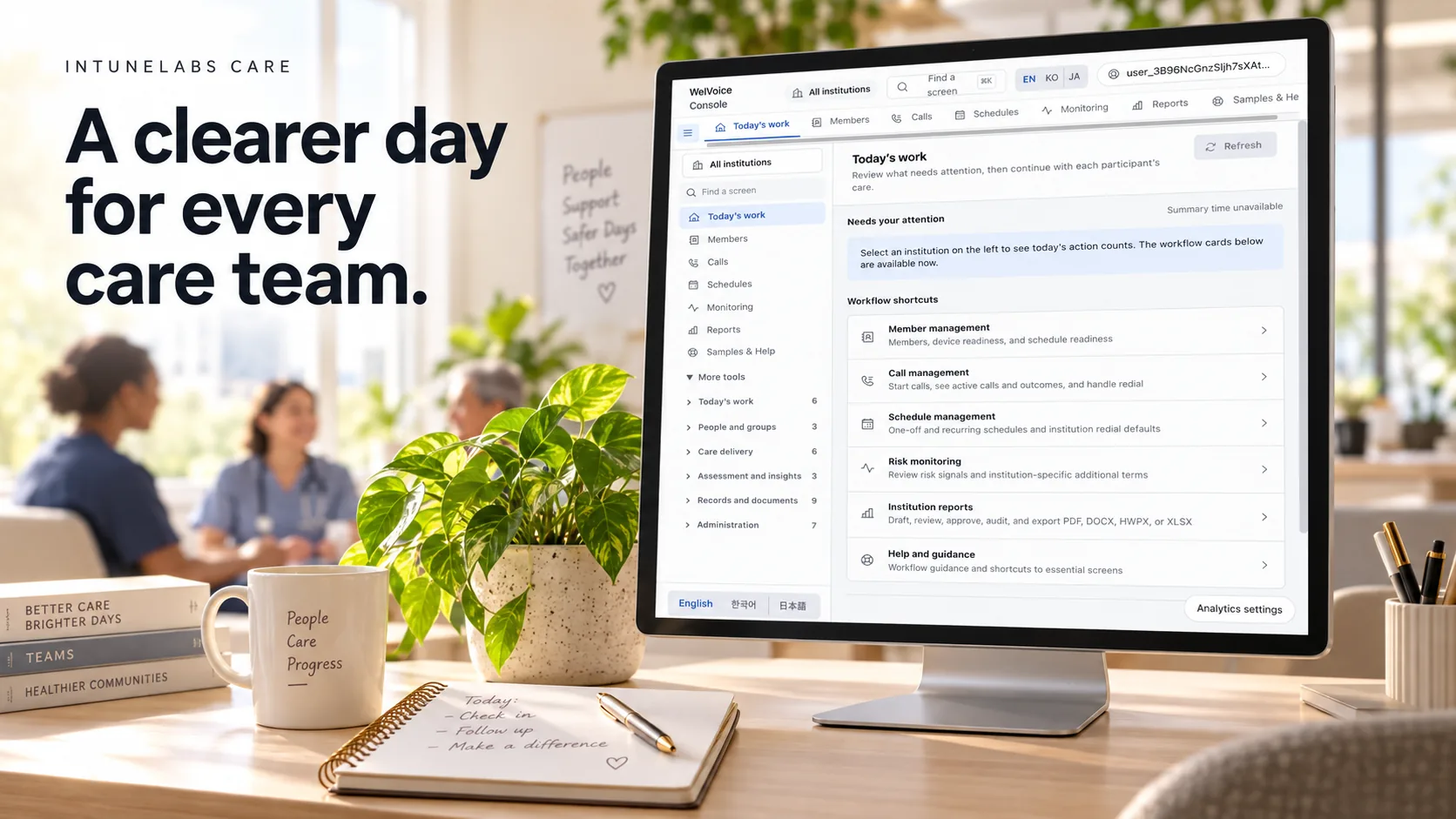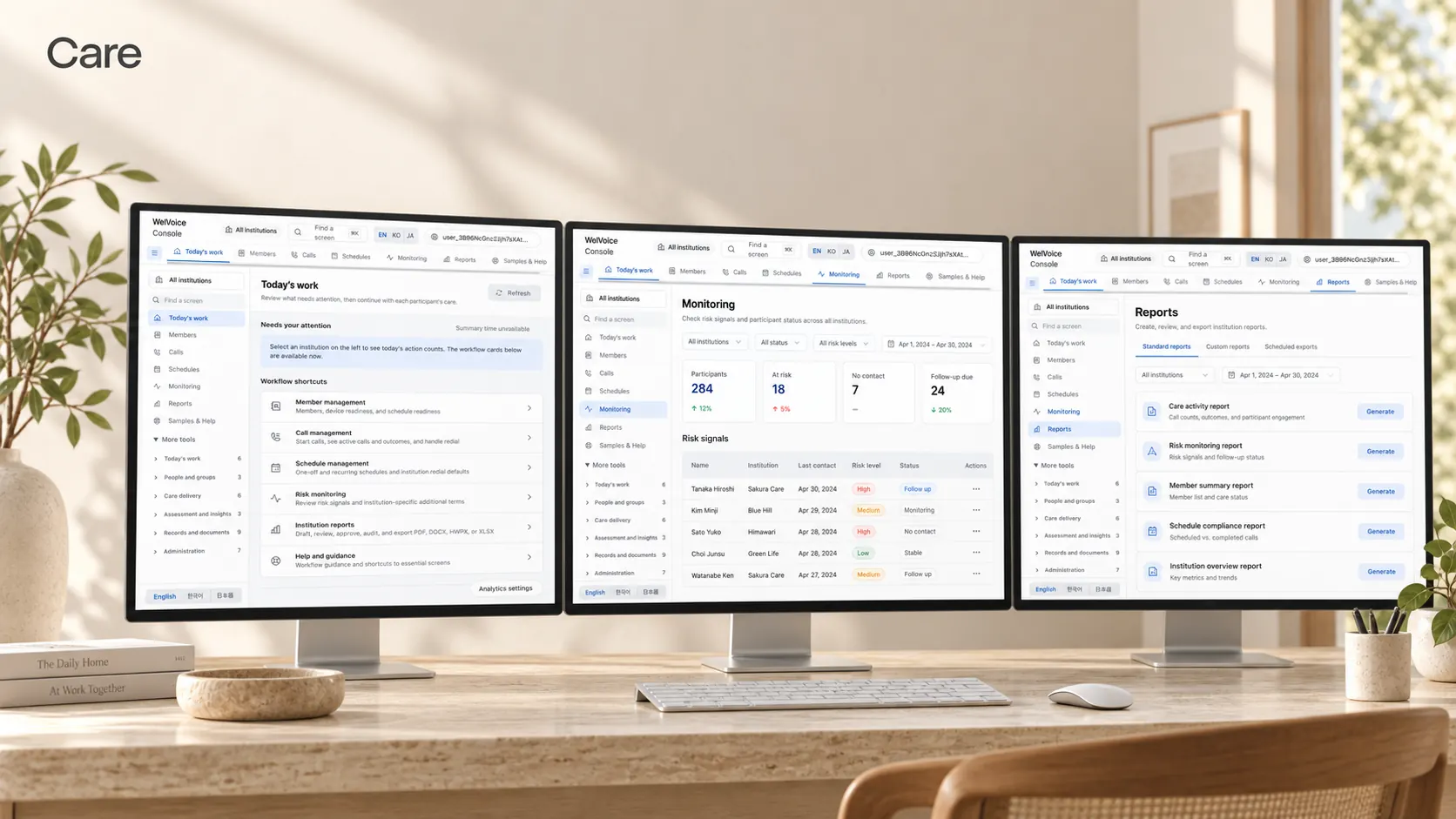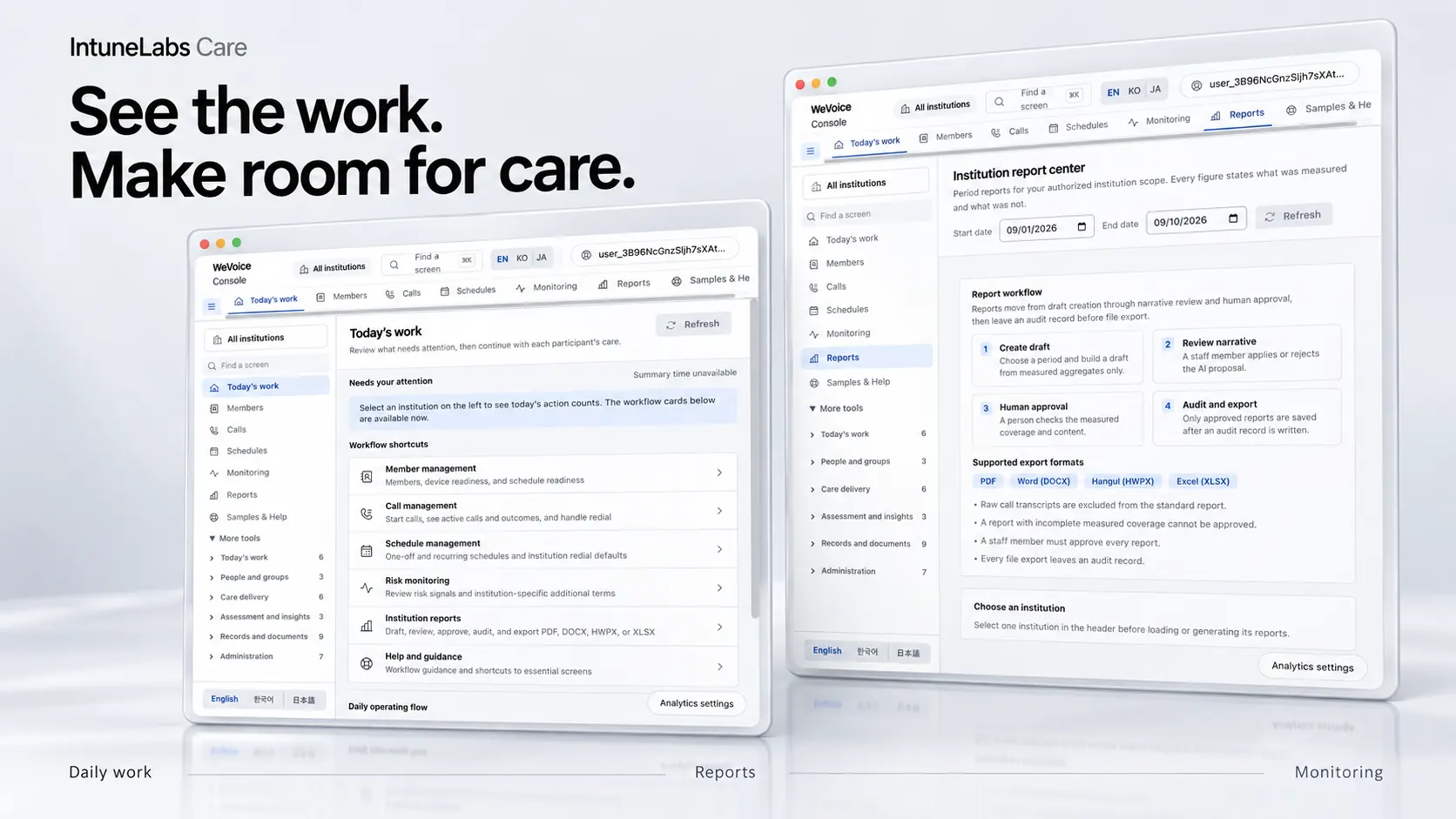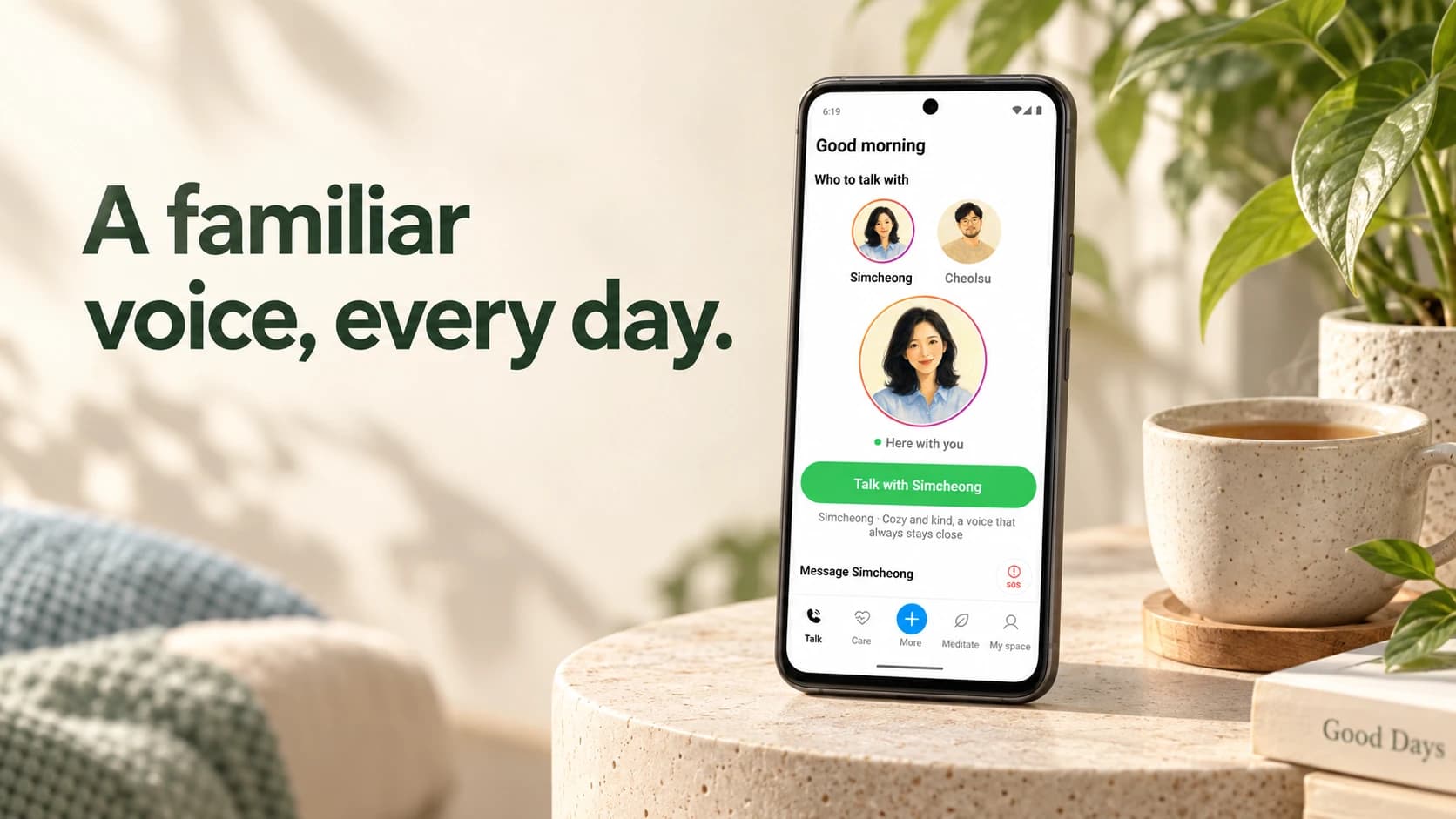
• Check-in callsWarm Korean check-in calls, held for care teams
  • Operator consoleBuild, monitor, and ship voice agents
  • PipelineRedaction and risk scoring run while the call is happening
  • Human gateEverything that reaches production passes one human gate

Warm Koreancheck-in calls for care teams,and the console that runs them

WelVoice holds warm Korean check-in calls for care teams, plus an operator console to build, monitor, and ship voice agents — built and operated in-house on IntuneLabs' own stack.

  • Voice-activity stopWhere a turn ends
  • Backchannel handlingNever cuts the speaker off
  • Inline processorsOne pass

In call

Transcript

Redacted

Realtime
Risk signals exist while the call is happeningConsole
TTS failoverSticky

Call record

One call

See the pipeline

VOICE ENGINECONSOLEWEBMOBILEBACKENDConversational AI

Both ends of the call

One end is a room someone lives in. The other is the desk that receives it.

A person talking at home

A check-in call happens at home,

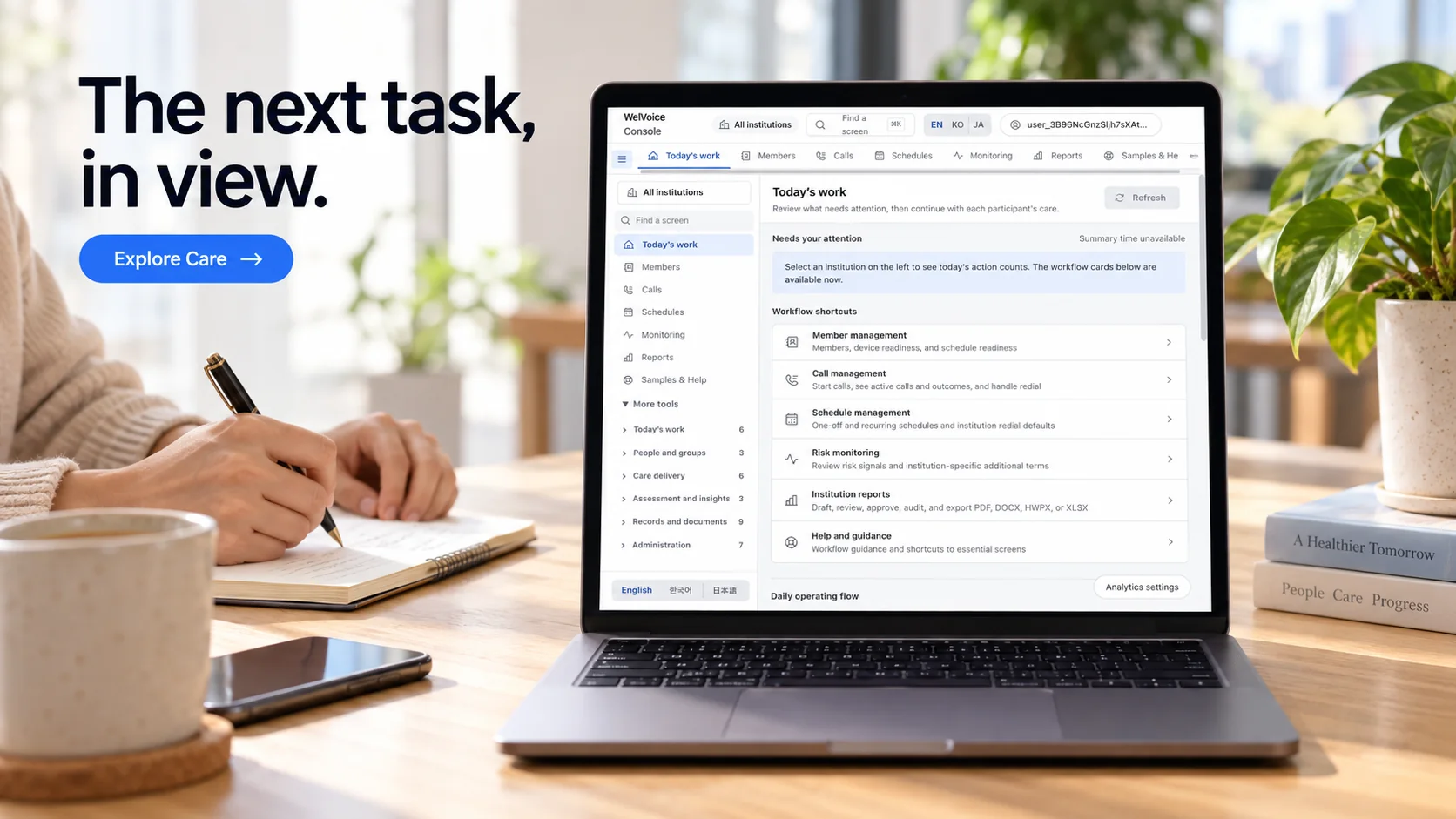
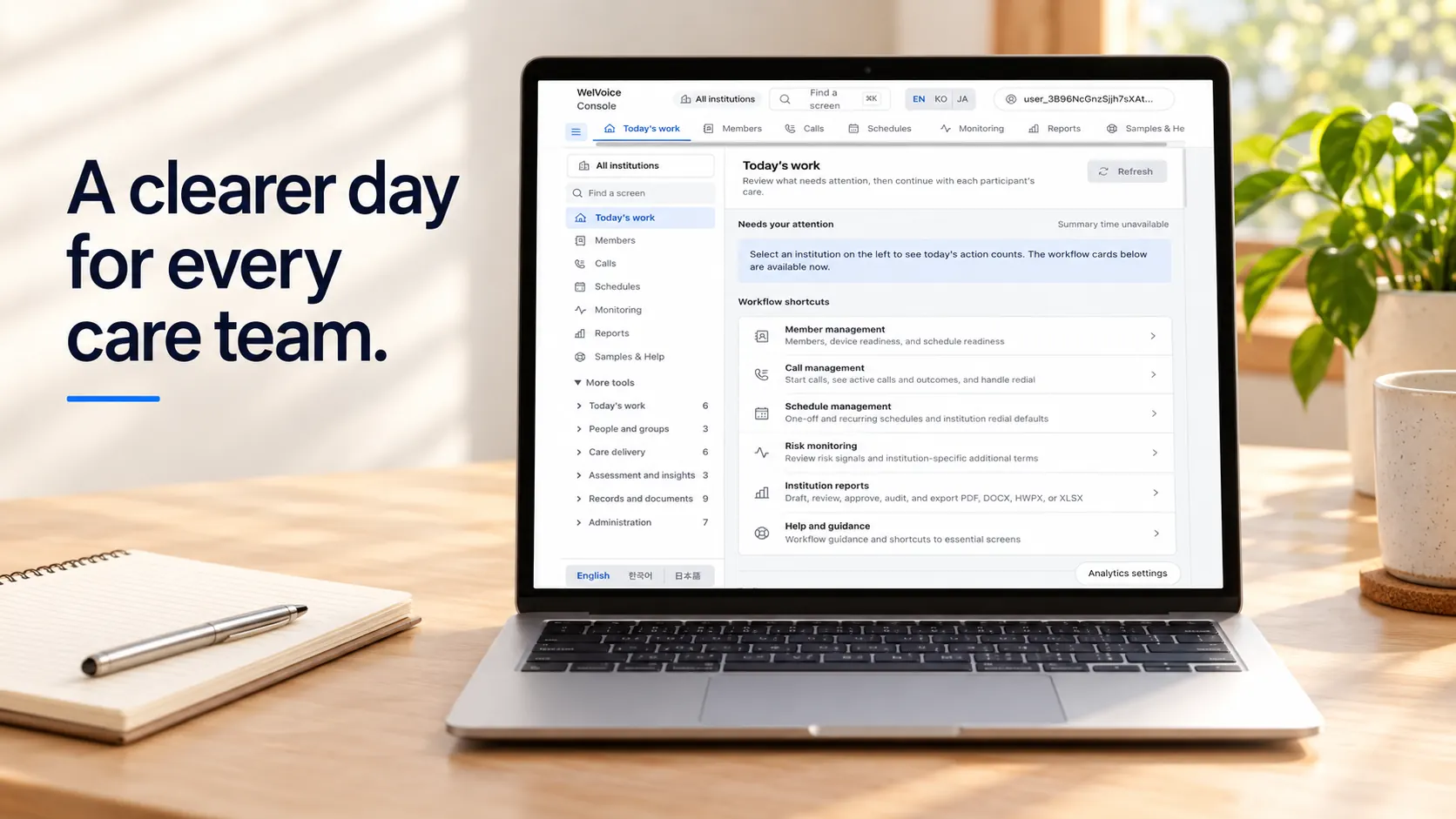
A tidy desk with a laptop and handwritten notes

and what it produces lands on the team's desk.

A bright workspace in daylight

Follow-up runs after a person confirms it.

Handled during the call

Redaction and risk scoring run inside the pipeline while the call is happening, and everything that reaches production passes one human gate.

Turn-taking, tuned for Korean speech.

A voice-activity stop decides when a turn is over. Backchannel handling keeps the pipeline listening through 네 and 음 instead of treating them as an interruption, so the caller finishes the sentence they started. Greetings are pre-synthesized at startup, so the first audio is already waiting when the call connects.

Voice-activity stop

Voice activity detection ends a turn at a short threshold — short enough to feel responsive, long enough to survive a normal Korean pause.

Backchannel handling

네, 음, and other listening noises are treated as backchannel rather than a new turn, so the pipeline keeps listening instead of cutting the speaker off.

Pre-synthesized greetings

The opening line is synthesized at startup and held ready, so the first thing a caller hears does not wait on a model round-trip when the call connects.

Guide

A closer look at one call.

See the voice engine
WelVoice

Product note

WelVoice is IntuneLabs' Korean-first realtime voice product — a web app and a native mobile app, with a care-operations layer behind them.

See the apps

30+

voice-pipeline processors we wrote

Repository audit, August 2026

See the platform

Processors, in a single pass.

Every turn runs through custom processors in a single pass — PII redaction, output guardrails, risk scoring, diarization, and Korean text normalization among them. They run inline rather than as a post-call batch, so what reaches the care-operations layer is already redacted, scored, and attributed.

Risk scoring

Each turn is scored inline as part of that pass, so risk signals exist while the call is happening rather than being assembled from a stored transcript afterwards.

The operator console showing agents and publish state

Guide

How we handle what we hear.

See safety
IntuneLabs

Product note

Numbers, units, and mixed-script text are normalized for Korean before synthesis, so spoken output reads the way a Korean speaker would actually say it.

See the voice engine

450+

operator-console components

Repository audit, August 2026

See the console

Degrade over crash. Every time.

Feature flags let the pipeline downgrade gracefully instead of dropping the call. If a synthesis vendor stalls mid-call, the pipeline fails over to another one and stays there. If a tool call runs long, Korean filler audio covers the gap instead of dead air.

Feature flags

Individual capabilities can be turned down one at a time, so a failing component costs a feature rather than the whole call. Degrading is the designed outcome, not the accident.

Sticky TTS failover

When a synthesis vendor stops responding mid-call, the pipeline switches to another one and stays there for the rest of that call instead of flapping between them.

The console screen with the provider failover chain

Korean filler audio

When a tool call runs long, short Korean filler audio covers the wait, so a slow lookup sounds like a pause rather than a dropped line.

Guide

What a call did. Measured, not guessed.

See the platform
WelVoice

Product note

Browser voice over WebRTC and native mobile voice are the transports running in production today. Telephony is built but key-gated — it is not carrying production phone calls.

See the integrations

100+

feature flags

Repository audit, August 2026

See the platform

What a call did. Measured, not guessed.

Every call reports what it actually did.

Time to first audio, per call

Time-to-first-audio is recorded for every call, so the number operations reads is what that call actually did — not a benchmark figure, and not an average that hides the slow ones. A bad call stays visible on its own.

Learn more

Time to first byte, per call

Time-to-first-byte is recorded alongside it, which separates a slow model response from a slow pipeline. Both are captured per call, so a regression has somewhere specific to point.

Learn more

Inline processors

Redaction, guardrails, risk scoring, diarization, and Korean normalization run in one pass over each turn rather than as separate post-processing stages.

Learn more

The turn threshold

Voice activity detection ends a turn at a short threshold, with backchannel handling layered on top so a listening 네 does not count as the caller handing their turn back.

Learn more

Bring the stack to your deployment

Security review

Go deep on the guard stack — the outbound secret scan, deploy guard, abuse suite, and CI checks.

Learn more
IntuneLabs

Orchestration, not ownership.

IntuneLabs does not train its own speech or language models. It orchestrates best-of-breed vendor models and builds the layer around them — Korean tuning, turn-taking, failover, guardrails, and the per-call instrumentation that says what a call actually did. That layer is the product.

IntuneLabs — our own position, stated plainly.

Next steps

Contact sales

Tell us about your governance and deployment requirements and we'll walk you through the fail-closed model in detail.

Contact sales

Ongoing assurance

A machine-checked topology check and a self-auditing CI keep the running estate matching the committed manifest.

Explore docs

How we handle what we hear.

Inline PII redaction

PII redaction runs as one of the inline processors, so identifiers are stripped during the call rather than cleaned up afterwards by a batch job over stored transcripts.

Learn more

We hold no certification

IntuneLabs holds no security or privacy certification, and this page claims none. Where a control exists it is described as what it does, not as an audited standard.

Learn more

Guardrails on every turn

Output guardrails and risk scoring run on every turn, in the same pass as redaction, so none of it depends on a separate service being reachable at that moment.

Learn more

01/03

30+

voice-pipeline processors we wrote

Every figure is counted directly from the repository — repository audit, August 2026.

Deployments you can compose from what is built

These are not customer stories. They are deployments you can compose from what is implemented today, and each one rests on something we built.

  • Check-in calls tuned for Korean speech

    The voice-activity stop, backchannel handling, and pre-synthesized greetings work together so the caller finishes the sentence they started.

    See the scenarios
    • Voice-activity stop
    • Backchannel handling
    • Pre-synthesized greetings
  • Processing that finishes before operations sees it

    Redaction, guardrails, risk scoring, diarization, and Korean normalization run inline in the stream rather than as a post-call batch.

    See the scenarios
    • PII redaction
    • Risk scoring
    • Korean text normalization
  • Calls that degrade instead of dropping

    Feature flags, sticky TTS failover, and Korean filler audio keep a vendor having a bad minute from becoming a caller with a dropped call.

    See the scenarios
    • Feature flags
    • Sticky TTS failover
    • Korean filler audio
  • Browser and mobile, with telephony ready

    Browser voice over WebRTC and native mobile voice are live today. The telephony transport is built but key-gated, and it is listed as built, not as shipped.

    See the integrations
    • Browser voice
    • Mobile voice
    • Telephony (key-gated)

Questions, answered honestly

A concept-level summary. The security answers are scoped to within the governed agent workflow.

One pipeline. Every surface it reaches.

The web app, the mobile app, and the care-operations layer behind them read from the same voice pipeline. A flag flipped for one is a flag flipped for the pipeline, not a per-surface fork — what changes in the pipeline changes everywhere it is consumed.

See the console

A human is the single gate to production

Autonomy up to the PR boundary, fail-closed everywhere past it. Talk to us about what that means for your deployment.

  • In-handler authentication
  • Fail-closed deploy guard
  • Topology conformance
  • PII redaction
  • Sticky TTS failover
  • One human gate