Support
Run the call that is live today. See plainly what is still gated.
Simcheong is the companion app. Care is the team workspace for schedules, calls, and monitoring. Console is where voices, prompts, and conversations are configured. This page is for operators and builders: product roles, implementation state, how a pilot is scoped, and the questions we already answer.
Pick the surface you will run
Companion app (Simcheong), team workspace (Care), or voice and agent setup (Console). How they share data is scoped per deployment.
Scope from one use case
Start from the work you will hand off, expected volume, and whether you need browser, mobile, or telephony.
Separate live from gated
Browser and mobile voice are live today. Telephony is built and key-gated, and is integrated per deployment.
Inspect data and the production gate
PII redaction runs inside the pipeline. Retention and access are scoped per deployment; unverified state fails closed.
Start from the surface you will actually run
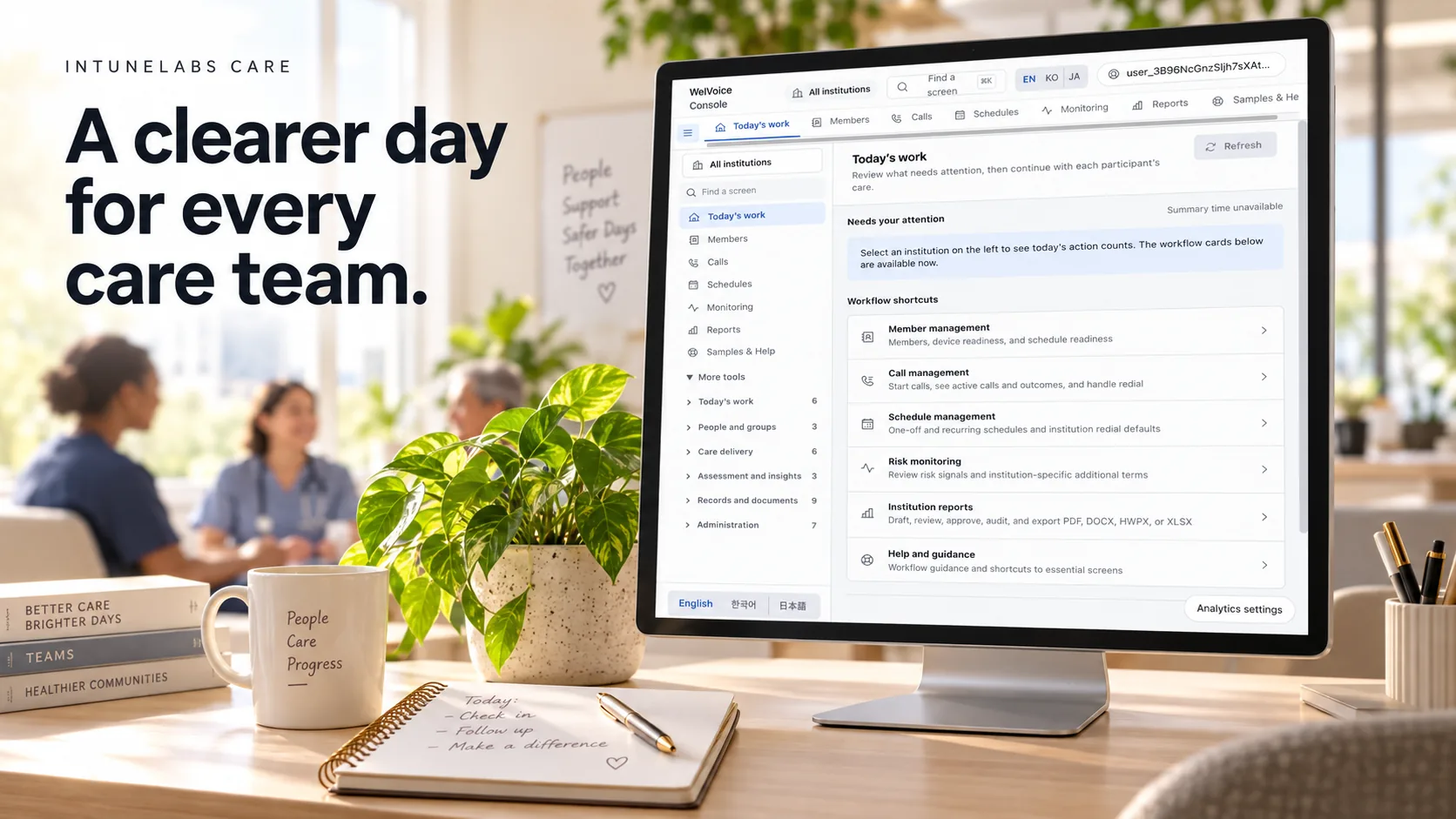
Spoken companion sessions live in Simcheong. Team schedules, calls, and monitoring live in Care. Voices, system prompts, and publish live in Console. How those products share data is scoped per deployment. The transports live today are browser and mobile.
Bring the call that failed, not a generic ticket
If a reply ran long or a turn was cut off, note the product, the transport (browser, mobile, or telephony), and which stage stopped. That is what lets us tell a live path from a key-gated one from an app still being wired.
Reliability
Reliable by design. Not by promise.
A live call cannot be retried. Failure modes are chosen ahead of time, not hoped away. The pipeline is not working-or-erroring — it is a system that can step a capability down and hold the call.
When a vendor wavers mid-call, the rest of that call pins to another provider; when one of our own capabilities is uncertain, a flag steps it down. Unverified state fails closed, and a person is the only gate to production.
Implementation state
What is open right now
This is implementation state, not an availability dashboard: whether each capability is live, built but gated, or still in development. How each one is put together is in the documentation.
- Live
- Built and gated
- In development
| Choose a surface | VoiceThe live call path — transports, pipeline, and processors. | ConsoleWhere an operator closes out the work after a call. | AppsThe web and mobile surfaces families and care teams use. |
|---|---|---|---|
| Browser WebRTC calling Starting a call in the browser with nothing to install. | LiveLive | LiveVisible in calls | LiveStarts from web |
| Mobile calling iOS and Android apps reaching the same voice engine. | LiveLive | LiveVisible in calls | LiveiOS · Android |
| Telephony integration The architecture is built but key-gated, and is not running as production phone calls. | Built and gatedKey-gated | Built and gatedPer deployment | Built and gatedPer deployment |
| Live transcription Transcription accumulates while the call runs and is read back afterwards. | LiveUpdates in call | LiveReviewable | Built and gatedSurfacing in progress |
| Recording and call records Recordings and records are stored for later review. | LiveStored | LiveRecord review | In developmentIntegration in progress |
| Custom processors PII redaction, output guardrails, risk scoring, diarization, Korean normalization. | Live30+ processors | LiveResults visible | LiveResults applied |
| Feature-flag rollout Opening capability in stages, and stepping it down when conditions get worse. | Live100+ flags | LiveState visible | LiveStaged exposure |
| Care and manager apps UI is complete; backend integration is in progress. | LiveEngine ready | Built and gated34 domain modules | In developmentUI complete, wiring up |
| Schedules and follow-up Wiring regular calls and post-call work into the operating rhythm. | Built and gatedTriggers ready | LiveHandled in console | In developmentIntegration in progress |
| SOC 2 · HIPAA · GDPR certification We do not currently hold these. What we offer instead is inspectable engineering controls. | In developmentNot held | In developmentNot held | In developmentNot held |
This table does not describe availability or uptime. It states which implementation stage each capability is at; what actually opens for a given deployment is scoped with you during the engagement.
Talk about a deployment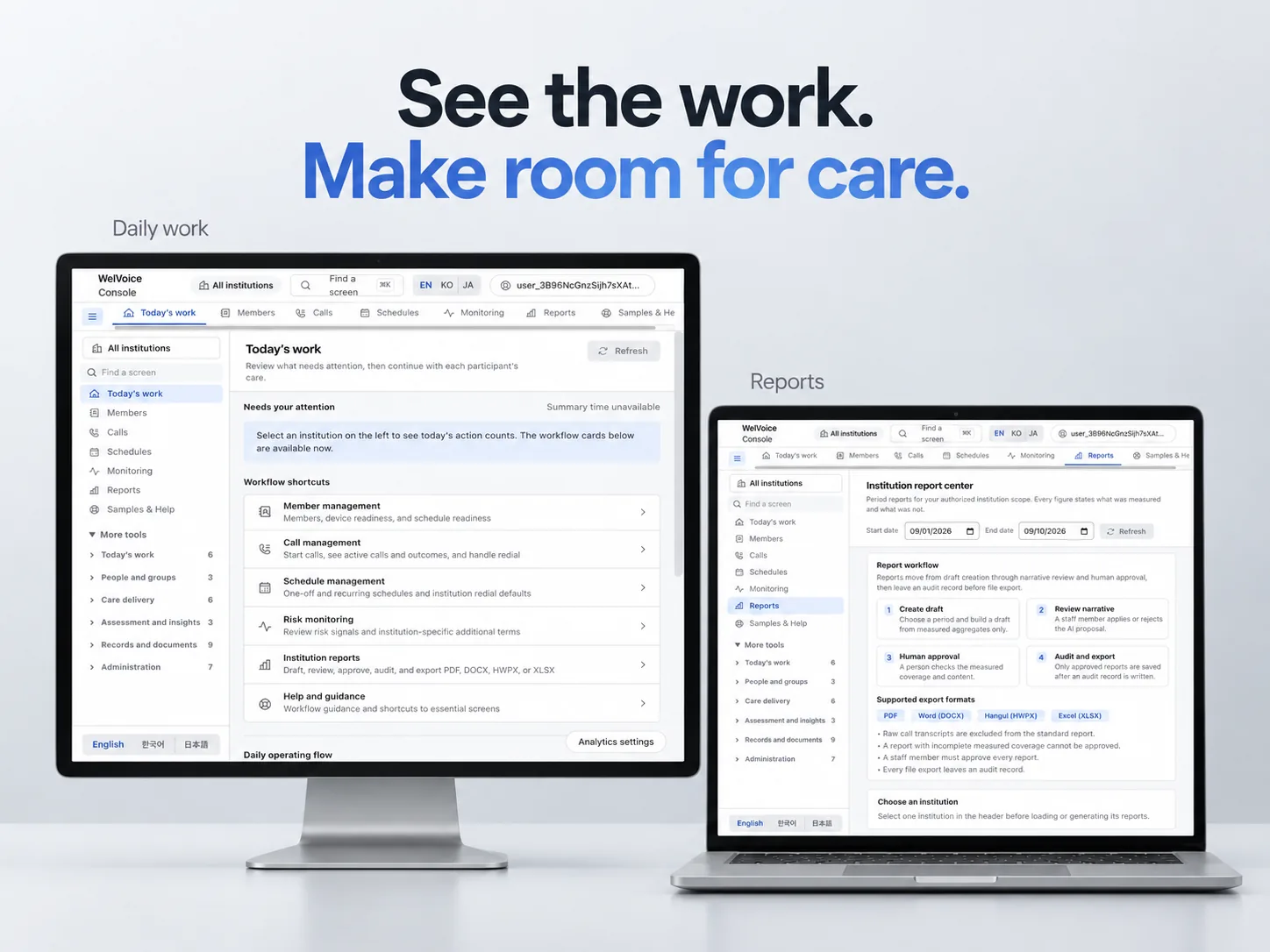
How a deployment gets decided
Instead of a customer story, here is the order scope is actually settled in. A pilot proves one use case against the live stack, and the path to production is drawn from there.
- Starting point
- We start from your use case, expected volume, and integration surface. We don't publish list prices, and pricing is per deployment rather than by a fixed plan or a per-credit meter.
- Pilot
- A pilot proves one use case against the live stack with your team in the loop. This is the stage where what actually works inside a call becomes visible.
- To production
- From there we add concurrent agents, custom processors and guardrails, TTS failover, and feature-flag rollout, and move you onto a production deployment. Telephony, if you need it, is integrated during this process.
We don't claim to own or train the models. What we build is the Korean tuning, the orchestration, and the reliability layer around them.
Working together
Find the next step in your work.
Care's help area points you to member management, calls, schedules, and reports. Find the task you need, then ask about the service your team uses.
Get in touch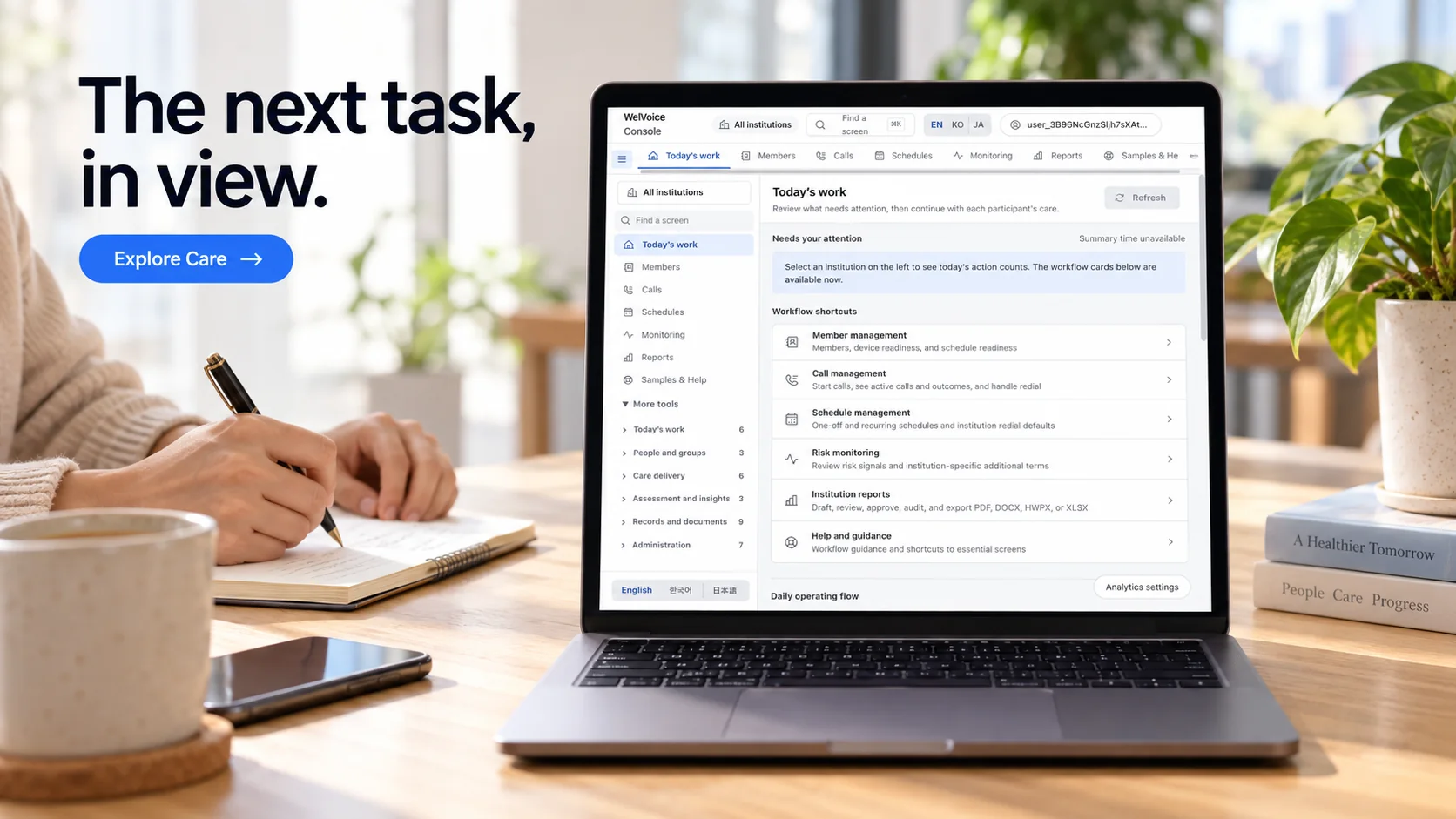
Common questions
Questions we already answer
What a Korean-first voice deployment includes, and what it does not — transports, pricing, models, certification, data. Type a word to narrow the list.
6 questions match.
What do you provide?
An agent that holds a spoken conversation in Korean, an operator console to review those conversations afterward, and Care as the team workspace for schedules and calls. The transports live today are browser and mobile.
How is a deployment priced?
Per deployment, not by a fixed plan or a per-credit meter. We start from your use case, expected volume, and integration surface, then quote a pilot and a path to production. We don't publish list prices.
Can you connect to our phone system?
Not out of the box. The pipeline ships a telephony-ready architecture, but the transport modules are key-gated and are not running as production phone calls. Telephony is integrated per deployment. Browser and mobile voice are the transports live today.
Which speech and language models do you use?
We orchestrate best-of-breed vendor models for speech-to-text, language, and text-to-speech. We don't claim to own or train them — our work is the Korean tuning, the orchestration, and the reliability layer around them.
Are you SOC 2, HIPAA, or GDPR certified?
Not yet. We do not currently hold SOC 2, HIPAA, or GDPR certifications. What we offer today is inspectable engineering controls — a fail-closed deploy guard, in-handler authentication, and CI checks on every change — and we're happy to walk your security team through them directly.
What happens to conversation data?
PII redaction runs inside the pipeline as one of the processors. Retention, storage location, and access for a given deployment are scoped with you during the engagement rather than assumed.
Not an emergency service
IntuneLabs voice agents are not for emergencies and must not be relied on in one. If you or someone else is in immediate danger, call 119 (fire and medical) or 112 (police) right away.
We scope the first use case with you
Tell us the work you will hand off and the transport you will use — browser, mobile, and telephony per deployment if you need it — and we will map a path to a pilot on the live stack.
This page carries no response-time commitments, no tiered support pricing, and no uptime figures. Those are values we do not publish — what is here instead is the current implementation state of each capability.
The figures are 30+ voice-pipeline processors, 100+ feature flags, 450+ operator-console components, and 34 backend domain modules — each counted in the repository during the August 2026 audit.