Quoted per deployment — not from a price list.
How it is priced
Voice AI is software that listens and talks with people. We quote from the work it should do, expected volume, and whether it must run in the browser, on mobile, or on a telephony path that is still key-gated. We do not publish list prices, per-minute rates, or per-seat figures.
Scope with salesCustom
We don't publish list prices
What shapes the quote
Start with one task to try on a small scale. We review the features, expected call volume, tools to connect, and what everyday operation would need. A pilot proves that one use case against the live stack.
Prepare to get started- The work to support
- Expected call volume
- Tools to connect
- Your operating needs
In every deployment, out of the box:
Korean-first tuning
- Turn-taking
- Backchannel handling
- Korean text normalization
- English-capable agents
Inline processing
- PII redaction
- Output guardrails
- Risk scoring
- Diarization
Operator console
- Call records
- Live transcripts
- Follow-up actions
- Shared access
Per-call observability
- Time to first audio
- Time to first byte
- Captured per call
Reliability layer
- Degrade over crash
- Sticky TTS failover
- Korean filler audio
- Feature flags
Transports
- WebRTC (browser)
- Mobile transport
- Telephony-ready (key-gated)
Deployment support
- Onboarding
- Scoping
- Per-deployment integration
In-handler authentication
- Auth in every function
- Fail-closed deploy guard
- A human gate to production
Engagement tiers
Pilot to production, on the same stack
All three tiers are quoted per deployment. The values below are not amounts — they are what each tier actually opens, and what state that capability is in today.
Engagement tiers
Choose Pilot to prove one use case against the live stack, Production to run that stack on your workflow, and Enterprise when isolation, SSO, and dedicated support are part of the buy.
Pilot
A scoped proof-of-concept for a single voice-agent use case.
- One voice-agent use case, scoped with your team
- Korean-first tuning, English-capable
- WebRTC (browser) or mobile transport
- Shared operator-console access
Price
Custom
We don't publish list prices
Concurrent voice agents
1 use case
Korean-first tuning
Included
English-capable agents
Included
Production
A live voice-agent deployment operating on your workflow.
- Multiple concurrent agents
- Custom processors and output guardrails
- TTS vendor failover for call continuity
- Feature-flag rollout
Price
Custom
We don't publish list prices
Concurrent voice agents
Multiple
Custom processors and guardrails
Included
Feature-flag rollout
Included
Enterprise
Scale, security, and governance across your organization.
- Isolated backend and data controls
- Audit logging and fail-closed deploy guards
- SSO and granular role permissions
- Dedicated deployment team
Price
Custom
We don't publish list prices
Concurrent voice agents
Multiple, scaled
Isolated backend and data controls
Included
Audit logging
Included
Capabilities
Compare capabilities and state, not amounts
Every engagement is scoped and priced per deployment rather than by a fixed plan or credits. What this page can put side by side is not a price list: it is what each tier actually opens, and whether that capability is live or still key-gated.
Contact salesBuild your deployment
Work with our team to design a configuration that meets your needs:
What comes with it
- Scoping and onboarding
- Per-deployment integration
- Per-call latency observability
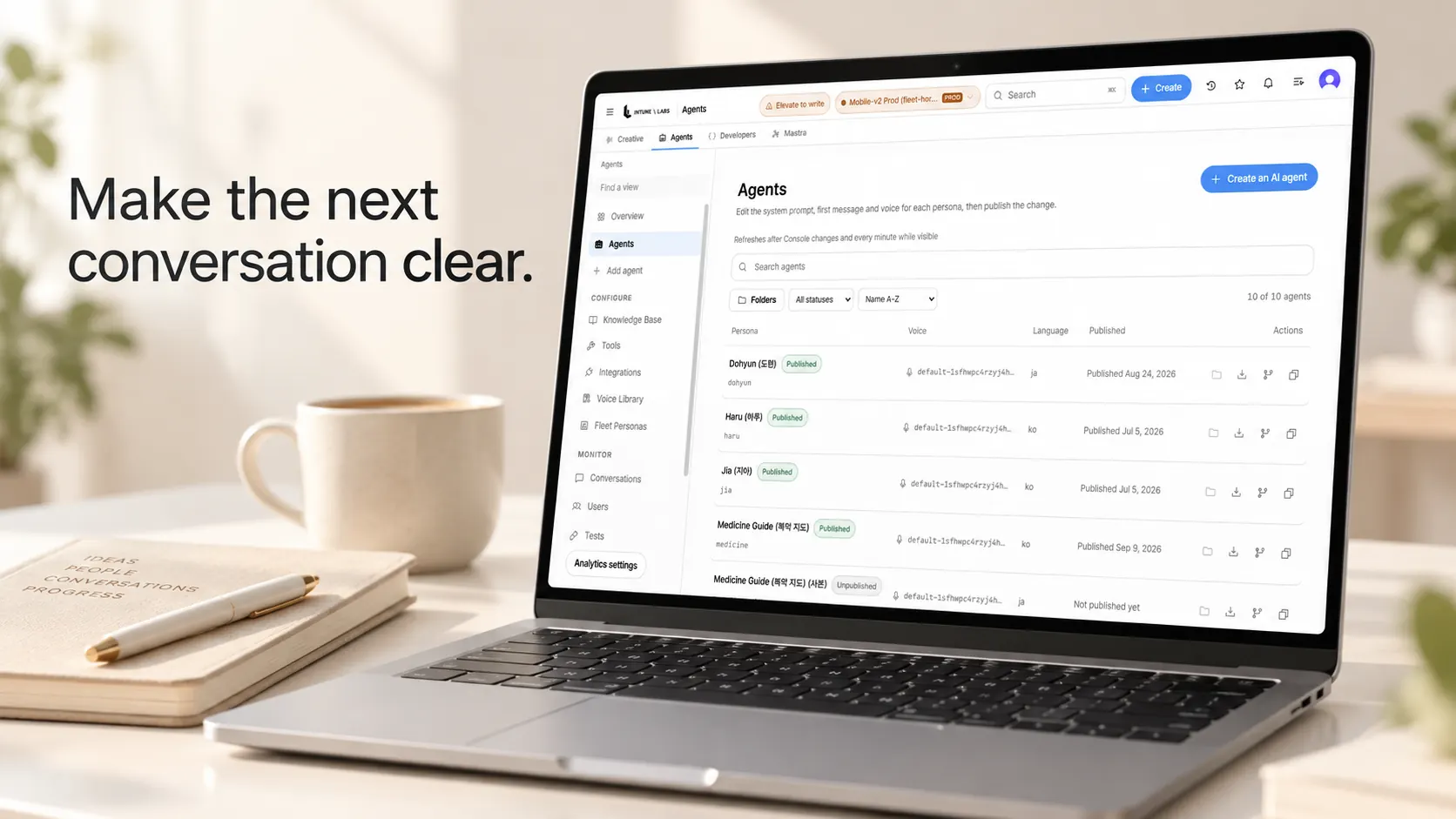
Flexible configuration
Start from your use case, expected volume, and integration surface, and configure only what that needs.
Scoped quoting
Priced per deployment rather than by a fixed plan or credits.
Korean-first, English-capable
The pipeline is optimized end-to-end for Korean conversation, and the agents are English-capable as well.
Per-call transparency
Time-to-first-audio and time-to-first-byte are recorded per call, so the number operations reads is what that call actually did.
We don't publish list prices
Start with one task to try on a small scale. We review the features, expected call volume, connections to existing tools, and what would be needed for everyday operation. Contact sales and we will work it out with you.
Talk to salesThese are deployments you can compose from what is implemented today — not customer stories.
Korean-first
Turn-taking and backchannel handling tuned for the language
Pre-synthesized
First audio already waiting when the call connects
Capabilities used
Voice engine, operator console
Korean check-in calls tuned so the caller finishes the sentence they started.
See the scenariosFrequently asked questions.
Exploring a first use case?
We scope pilots with teams evaluating Korean-first voice agents. Tell us the work, the expected volume, and which transports must be live, and we will map a path to proving it on the live stack.
Deployments for care teams
Check-in calls, inline processing, and the follow-up work finished in the operator console.
Learn more¹ No value on this page is an amount. IntuneLabs does not publish list prices; every engagement is quoted per deployment.
² The telephony transport is built and key-gated, and is not carrying production phone calls. Browser and mobile voice are the transports live today.