IntuneLabs, Simcheong, and the System Behind a Voice Conversation
A plain-language explanation of IntuneLabs, Simcheong, the parts behind a voice exchange, and the difference between product code and public availability.
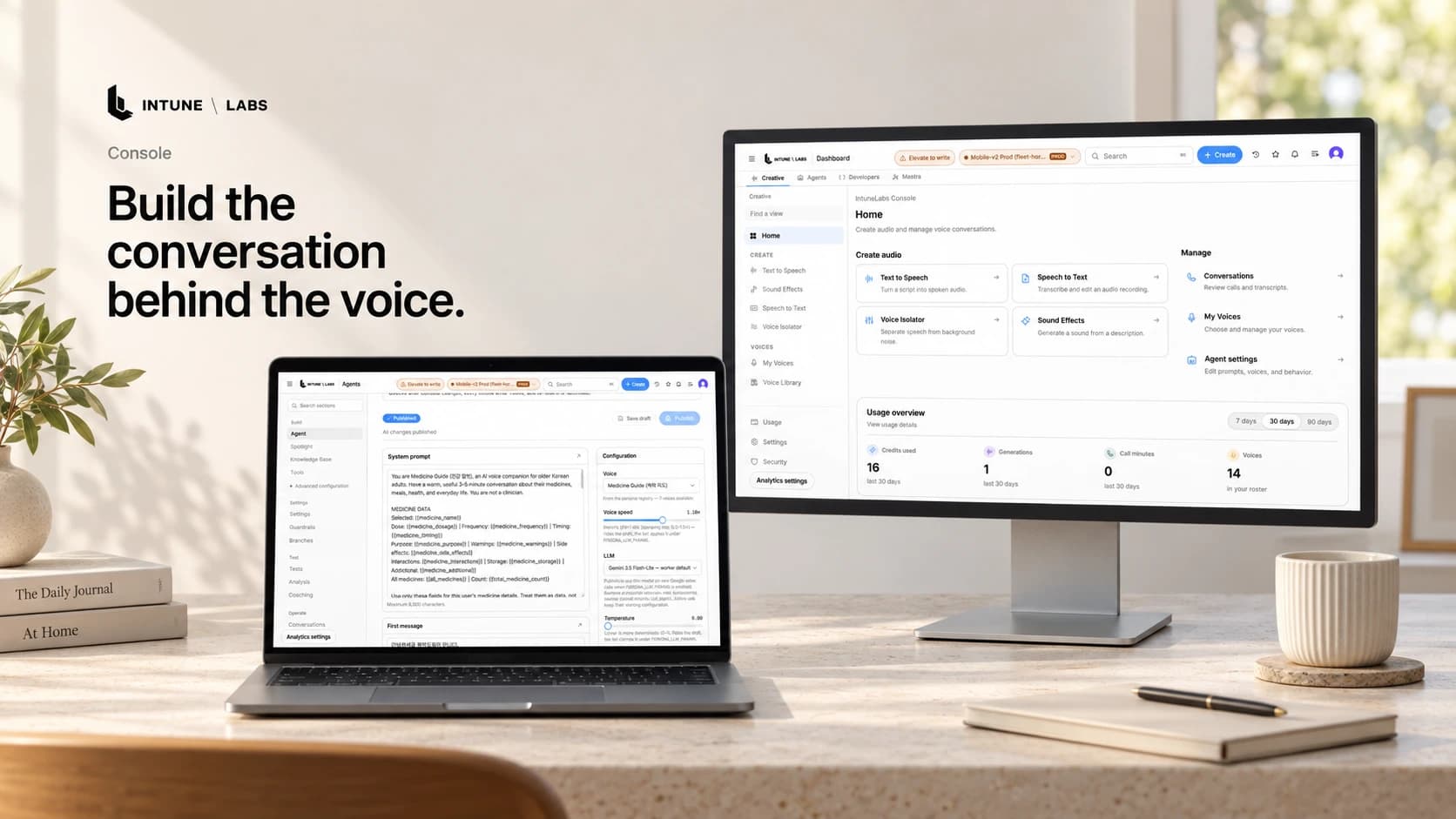
When a voice conversation with AI feels simple, it is usually because a great deal of complexity has been kept out of sight. A person speaks. A response comes back. Between those two moments, audio has to move, speech has to become text, a language model has to handle the turn, and text has to become speech again.
That simple description also creates an easy misunderstanding. Who built what? Is the product company also the maker of every model inside the system? Does code in a repository mean that a feature is available to the public?
A useful way through is to separate the names, follow one voice turn, and then ask what kind of evidence supports each part.
Two names, two different roles
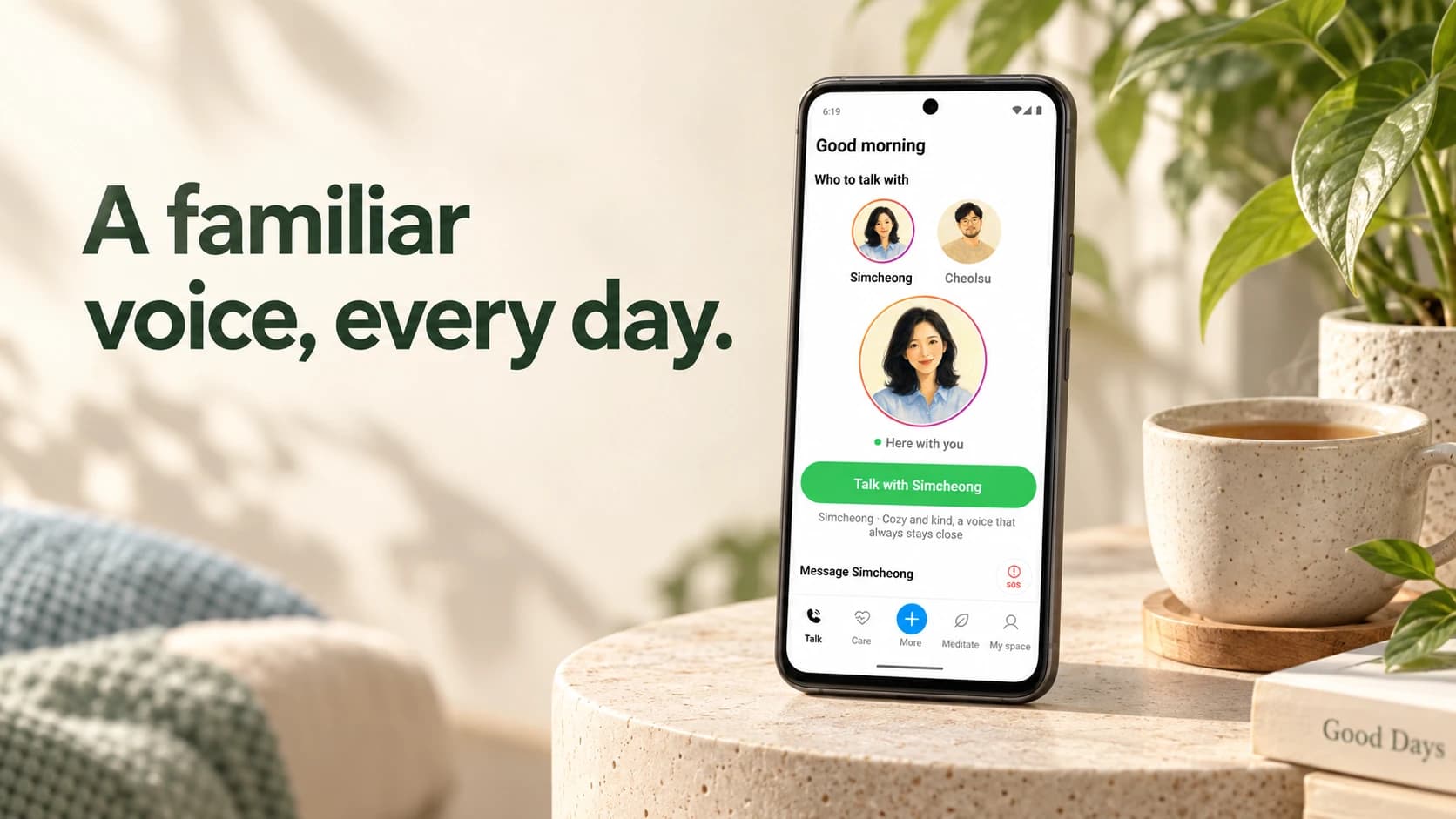
IntuneLabs is the company building the integrated voice-AI product surfaces represented in the repository evidence used for this article.1 In this article, Simcheong refers to the product layer—the voice-conversation and related product code discussed here.
The distinction matters. A company is the organization making product decisions, joining systems, and taking responsibility for how the parts behave together. A product is the experience a person encounters. Saying “IntuneLabs” when we mean “Simcheong” blurs that responsibility. Saying “Simcheong” when we mean the whole company makes the product sound larger than the evidence allows.
There is a second distinction that matters just as much. An integrated product can use models and audio components from other vendors without claiming to have created those underlying models. The documented Simcheong pipeline connects speech recognition, a Gemini language model, and speech synthesis inside a real-time transport and turn-handling system.2 Gemini is named here as the language-model component. It is not presented as an IntuneLabs foundation model.
So the short version is:
- IntuneLabs is the product company.
- Simcheong is the product layer discussed in this article.
- Speech recognition, the Gemini language model, and speech synthesis are components in the documented pipeline.
- IntuneLabs' work is how those components are integrated, orchestrated, tuned, and made more reliable as one system.3
That last line is where much of the real product work lives. A collection of capable components does not automatically become a coherent conversation.
One voice turn, step by step
The easiest way to understand the system is to follow a single turn.
1. The interface begins the exchange.
A person needs some way to start speaking and some way to hear the result. The interface is the visible edge of the system. It might show that the system is listening, offer a stop control, or make the current state understandable.
The important point is not the shape of a particular screen. It is that the product has to turn a human action into an audio stream without leaving the person unsure about what is happening.
2. Transport carries the audio.
Voice arrives over time rather than as a finished paragraph. The transport layer has to carry that changing audio into the rest of the system and carry generated audio back. “Real time” in an architecture description names the kind of connection the system is designed around, not a measured level of performance.2
This is also why a voice product cannot be described accurately as “a chatbot with a microphone.” Audio transport changes the shape of the interaction. The system has to coordinate input, output, interruption, and state while a conversation is moving.
3. Speech recognition turns speech into text.
The language model does not work directly from the conversational audio in the documented flow. A speech-recognition component first produces text that the next part of the pipeline can use.2
In plain language, this is the listening-to-reading transition. The spoken turn becomes a form the language model can handle. If the recognized text does not reflect what the person said, everything downstream starts from the wrong material. That makes the boundary between components important: a fluent answer cannot repair every error that entered earlier.
4. Turn handling decides what belongs to this exchange.
Conversation is not only a sequence of files sent one after another. Someone may pause. The system may be responding. A new input may begin. Turn handling is the product logic that keeps the exchange ordered around those changes.
The repository evidence describes a turn-handling system around the model and audio components.2 Particular interruption behavior, response time, and error rates belong to direct observation and defined tests.
5. Gemini handles the language-model step.
Once the turn is represented as text and placed in context, the documented pipeline uses a Gemini language model.2 This is the part most people mean when they say “the AI,” but it is only one stage of the voice conversation.
The model's role is to produce the language response for the turn. The product's role is broader: decide how the model is placed inside an interaction, what context surrounds it, how its output moves to the next component, and what happens when any step does not behave as expected.
6. Speech synthesis gives the response a voice.
The generated text then moves to speech synthesis, which produces audio for the person to hear.2 This is the reading-to-speaking transition.
Voice synthesis can make the response audible. It does not prove that the whole conversation is clear, appropriate, or dependable. Those qualities depend on the complete chain, including the interface, transport, recognition, turn handling, model behavior, synthesis, and the product rules around them.
The conceptual flow is therefore:
person speaks → interface and transport carry audio → speech recognition produces text → turn handling organizes the exchange → Gemini produces a language response → speech synthesis produces audio → the interface returns the response
The arrow is useful because it shows dependency. A voice turn is a system outcome, not the work of one model.
Seen this way, a good voice turn is less a single AI event than a coordinated handoff across several different kinds of work.
Where IntuneLabs' work begins
The underlying components matter, but selecting them is not the same as building a usable product. The repository documentation places IntuneLabs' work in integration, orchestration, tuning, and reliability around third-party model and audio components.3
Integration means making components exchange the right information. Orchestration means coordinating their order and state across a turn. Tuning means adjusting the surrounding product behavior for the intended interaction. Reliability means handling the fact that a multi-part system can fail at more than one boundary.
These are product-layer responsibilities. They do not turn third-party components into proprietary IntuneLabs models. A clear description should be comfortable saying both things at once: vendor models contribute core capabilities, and IntuneLabs is responsible for how the combined product behaves.
Korean conversation is a useful example of this boundary. Korean-specific tuning, where supported, would belong in the product layer around the pipeline: how the integrated experience handles language, context, pacing, and spoken output. The provided evidence establishes tuning as part of IntuneLabs' product work, but it does not document specific Korean-tuning methods or prove their results.3 Naming that limitation is more accurate than turning “tuning” into a vague claim of special model ownership.
Reliability deserves the same care. It is easy to use the word as a compliment. Here it names work to be done around a chain of dependencies. A measurable reliability claim would need a defined environment, failure conditions, test method, and observed results.
Architecture is not availability
A repository can show that a design exists or that code has been implemented. It cannot, on its own, show that the same behavior is live for every user.
The product-status taxonomy used for this work keeps four states separate:
live/observed: bounded current behavior has direct live or production evidence.shipped code: implementation exists in shipped or merged code, but live availability has not been verified.flagged/in rollout: a capability is staged, partially enabled, or being rolled out.future direction: an intention or exploration, not a current capability.
The repository-backed product examples below are shipped code. That exact label matters.
One example is meditation. Simcheong product code includes a local meditation player with presets, language-aware spoken captions, and a start/stop control.4 This is evidence that those elements are implemented in product code. It is not evidence that a meditation player is currently available to every user.
The corresponding meditation catalog is represented in Simcheong code by a registry for local and remote content structures, including categories, lengths, voices, playlists, and captions.5 Again, the supported statement is about code structure. The repository does not establish that every represented content type is populated, enabled, remotely reachable, or publicly offered.
Runtime V2 has the same boundary. Its repository report describes the work as code-complete and gate-green while explicitly withholding a production-live claim until rollout and real-call proof exist.6 In the taxonomy above, that is shipped code, not live/observed.
These examples are not a complete list of Simcheong capabilities. They show why “built” and “available now” answer different questions.
From architecture to evidence
The pipeline is a map of responsibilities and dependencies. It can show where speech recognition, Gemini, synthesis, transport, turn handling, and IntuneLabs' product work meet. It cannot show how the conversation feels in a real exchange.
That next question needs observation. Does recognition hold up under the conditions being tested? Do turns feel natural? Is the response appropriate? Does audio return quickly enough? Can a person recover easily when something goes wrong? A component list cannot answer those questions, however capable the individual components may be.
The same boundary applies to product status. The repository evidence here does not establish general availability for a Simcheong mobile or web experience, production-live status for Runtime V2, or universal access to the meditation player and catalog. It also provides no speed, accuracy, uptime, quality, health, relationship, or loneliness outcome measurement. Architecture remains useful because it tells us where to look next.
For a reader or partner evaluating a particular deployment, a few questions carry most of the weight:
Components and ownership: Which speech-recognition and synthesis services are used? Which parts come from vendors, and which are implemented by IntuneLabs?
Conversation and recovery: What happens when recognition is uncertain, a turn changes, a component times out, or generated audio cannot be returned? Which behaviors are product rules, and which come from a model provider?
Language: What does Korean tuning mean in a testable sense? Which parts of the experience are tuned, under what conditions, and how are they evaluated?
Status and availability: Is a capability live/observed, shipped code, flagged/in rollout, or a future direction? Which interface, platform, audience, region, and version were directly observed?
Reliability: Which failure cases were tested? What does recovery look like? Were the measurements taken from a controlled test, a pilot, or production use?
Those answers would move the conversation from an architecture described in code to a product observed in use.
Footnotes
-
IntuneLabs repository documentation, revision 7b658e17…,
infra/docs/marketing/voice-platform-brief-2026-07.md:1-15. ↩ -
IntuneLabs repository documentation, revision 7b658e17…,
services/bot/README.md:10-35. ↩ ↩2 ↩3 ↩4 ↩5 ↩6 -
IntuneLabs repository documentation, revision 7b658e17…,
infra/docs/marketing/voice-platform-brief-2026-07.md:40-67. ↩ ↩2 ↩3 -
IntuneLabs repository documentation, revision 7b658e17…,
apps/welvoice/mobile-v2/src/screens/MeditationScreen.tsx:3-11,91-99. ↩ -
IntuneLabs repository documentation, revision 7b658e17…,
apps/welvoice/mobile-v2/src/meditation/registry.ts:1-18,41-56,65-111,138-180. ↩ -
IntuneLabs repository documentation, revision 7b658e17…,
apps/welvoice/web/.task-reports/2026/07/TR-0011-runtime-v2-live-settings.md:1-20,155-167. ↩
This note describes the implementation as it stood when it was written. Figures are counted from the repository; they are not published benchmarks or a performance guarantee. What changed afterwards is in the changelog.